Introduction to 7 Principles of Testing
Short answer
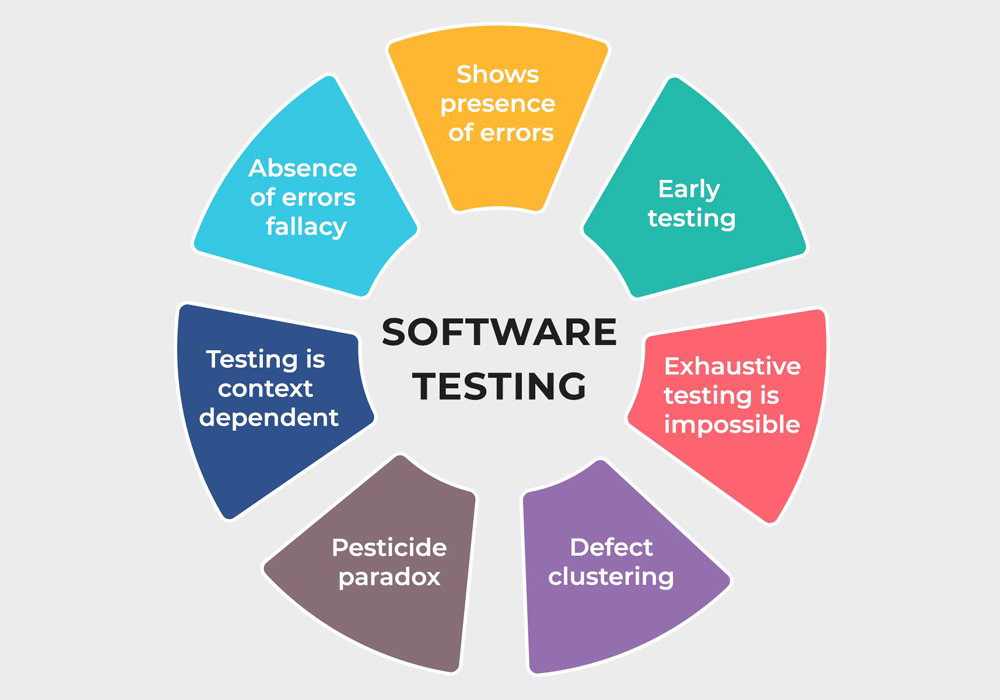
The seven principles of software testing, as set out in the ISTQB Foundation syllabus, are: testing shows the presence of defects, not their absence; exhaustive testing is impossible; early testing saves time and money; defects cluster together; tests wear out if they are never changed (the pesticide paradox); testing is context dependent; and the absence of errors is a fallacy, because software with no known bugs can still fail the people who use it.
The 7 Principles at a Glance
| # | Principle | What It Means | BetterQA Application |
|---|---|---|---|
| 01 | Testing shows presence of defects | Finding bugs proves they exist, not that none remain | We track defect escape rate to measure what we miss |
| 02 | Exhaustive testing is impossible | You cannot test every combination | Risk-based testing prioritizes critical paths first |
| 03 | Early testing saves time and money | Bugs found early cost 100x less to fix | Shift-left with automated checks in CI/CD |
| 04 | Defects cluster together | 80% of bugs come from 20% of modules | Historical defect data guides test focus |
| 05 | Pesticide paradox | Same tests stop finding new bugs | We rotate test suites and add exploratory testing |
| 06 | Testing is context dependent | No single approach works everywhere | Different strategies for fintech vs e-commerce |
| 07 | Absence of errors is a fallacy | Bug-free does not mean user-ready | UAT validates business requirements, not just code |
How BetterQA's 50+ Engineers Apply These Principles
Our dashboards show defect density per sprint. When a module hits zero bugs, we increase exploratory testing. Absence of found bugs triggers deeper investigation, not celebration.
Every PR runs through our automated test suite before merge. We catch 73% of defects before code review. The remaining 27% are found in staging - almost none reach production.
We maintain a "hot spot" map for each client project. Modules with historical defect clusters get 3x the test coverage.
Test rotation schedule: every quarter we archive 20% of stable tests and write new scenarios. Exploratory testing sessions target areas not covered by automation.
Let’s dive into something that’s absolutely fundamental to the world of software testing: the 7 principles of testing. These principles were established by the ISTQB as a way to guide testers and developers in understanding what makes good testing, and why certain practices work better than others.
Now, you might be wondering: why are these principles so important? Well, over the years, as software development has evolved, so has testing. What was once a chaotic afterthought is now a disciplined practice, with these seven principles serving as the foundation.
Historical Context
Not too long ago, software testing was often done last-minute, right before the product was shipped out. This led to bugs slipping through the cracks and users getting frustrated. The introduction of these 7 principles of testing was a game-changer, making testing a structured process rather than a rushed task. It’s like turning chaos into something more predictable and manageable; definitely a win for the industry.
Importance in Modern Day
Fast forward to today, and software development cycles are faster than ever, thanks to methodologies like Agile, DevOps, and CI/CD. But even in this rapid-fire environment, the 7 principles of testing still hold strong. They’re the reliable guideposts that help keep quality in check, even in the face of constant change.
Principle 1: Testing shows the presence of defects
This principle is pretty straightforward: testing helps you find defects, but it doesn’t guarantee that all defects are found. The goal is to reduce the chances of defects being overlooked, but finding zero bugs doesn’t mean everything is perfect.
EXAMPLE
Imagine you’re testing the checkout process on an e-commerce website. If you find a bug, say, the discount code field isn’t working, it doesn’t mean the entire checkout process is broken. On the flip side, just because you didn’t find any bugs doesn’t mean it’s flawless. There could still be underlying issues.
Principle 2: Exhaustive testing
Here’s the truth: testing everything is impossible. Trying to cover all combinations and scenarios would be time-consuming and impractical. Instead, you focus on risk and priority, identifying which areas of the software are most critical to test.
EXAMPLE
You’re testing the login functionality. It’s not realistic to test every possible input combination (case sensitivity, special characters, etc.). Instead, focus on higher-risk issues, like security vulnerabilities or common user input mistakes.
Principle 3: Early testing
Testing shouldn’t wait until the end of the development cycle. The earlier you start, the cheaper it is to fix bugs. Testing early allows you to catch problems when they’re easier and less costly to resolve.
EXAMPLE
Let’s say you’re involved in reviewing requirements or user stories. The sooner you can flag issues, the better. It’s much cheaper to fix a requirement than to rewrite code after it’s been developed.
Principle 4: Defect clustering
Here’s a principle that’s pretty well-known: 80% of defects often come from just 20% of the software modules. This is called defect clustering. It’s the testing equivalent of finding that the majority of your problems come from a few specific areas.
EXAMPLE
You might find that bugs tend to concentrate around complex features, like user profile management. This is where it makes sense to focus extra testing resources, as these are the areas most likely to fail.
Principle 5: Pesticide paradox
The pesticide paradox suggests that if you keep running the same tests over and over, eventually those tests won’t find any new bugs. To get around this, you need to continuously update your test cases and create new ones that address different parts of the system.
EXAMPLE
If you’ve been using the same old regression test suite for years, it might be time for an update. New test cases are often necessary to expose new bugs that previous tests have missed.
Principle 6: Testing is context
Every project and domain has different testing needs. You wouldn’t test a healthcare app the same way you would test a gaming app. The 7 principles of testing apply differently depending on the context: banking, healthcare, and entertainment software all have unique requirements that must be considered when testing.
EXAMPLE
Testing an app that handles sensitive patient data? You’ll need to put much more emphasis on security and privacy, whereas a gaming app would have different priorities, like performance and user experience.
Principle 7: Absence-of-errors
A key point here: just because you find no defects doesn’t mean the software is ready for release. If the software doesn’t meet user needs or expectations, then it’s essentially useless, even if it’s 99% bug-free. This is why it’s crucial to ensure that your testing aligns with user requirements and expectations.
Real-World Scenario
Your mobile app might work flawlessly on the latest version of Android, but if your users are still on older versions, you might miss a critical bug. Testing only on one version doesn’t cut it; you need to test across all the environments where your users might be.
EXAMPLE
A feature could work perfectly but still not meet the user’s needs. Usability testing can reveal if the software, although bug-free, is still not doing what the user wants.
Find out more about our advice for the ISTQB exam in our article!
Stay Updated with the Latest in QA
The world of software testing and quality assurance is ever-evolving. To stay abreast of the latest methodologies, tools, and best practices, bookmark our blog. We’re committed to providing in-depth insights, expert opinions, and trend analysis that can help you refine your software quality processes.
Delve deeper into a range of specialized services we offer, tailored to meet the diverse needs of modern businesses. As well, hear what our clients have to say about us on Clutch!
If you would rather have a team apply these principles to your product than set it all up yourself, our managed testing services cover the planning, the testing and the reporting.
Frequently Asked Questions
Q: What are the 7 principles of software testing?
A: The ISTQB 7 principles are: (1) Testing shows presence of defects, (2) Exhaustive testing is impossible, (3) Early testing saves time and money, (4) Defects cluster together, (5) Pesticide paradox, (6) Testing is context dependent, (7) Absence-of-errors fallacy.
Q: What is the pesticide paradox in testing?
A: The pesticide paradox states that if the same tests are repeated, they eventually stop finding new bugs—like pests becoming resistant to pesticides. Teams must regularly update and expand test cases to find new defects.
Q: Why is exhaustive testing impossible?
A: Testing all possible inputs, paths, and conditions would take infinite time and resources. Instead, testers use risk-based testing to prioritize critical functionality and use techniques like boundary value analysis and equivalence partitioning.
Q: What does testing is context dependent mean?
A: Different software requires different testing approaches. A medical device needs rigorous safety testing, while a marketing website may focus on user experience. The context (industry, risk, users) determines the appropriate test strategy.
Need help applying these principles?
15 years of QA experience, 5 proprietary tools, and 50+ engineers ready to help. Let's talk about your testing challenges.
Get expert QA that follows every principle
BetterQA applies these 7 principles across every project - from test planning to defect prevention. 50+ engineers, 15+ years of experience.
Talk to Our QA Team“These 7 principles aren’t academic theory – they’re battle-tested truths. Every principle I’ve seen violated has cost a company real money and reputation.” — Tudor Brad, Founder of BetterQA (15+ years in QA)
Need help with software testing?
BetterQA provides independent QA services across manual testing, automation, security audits, and performance testing. ISO 27001, 9001, 14001 and 13485 certified.